Useful Links
- Visit My Harbour – Solent Pilotage
- Weatherand Tide
Popular Destinations
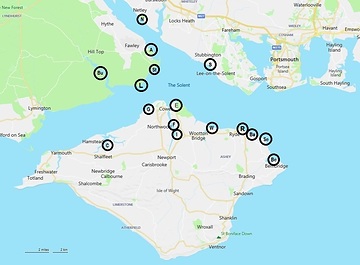
To find out more about our popular cruise destinations, go to Cruise Destinations.
Radio Communications
If you have a VHF radio then two channels to monitor are 11 for Portsmouth QHM and 12 for Southampton VTS as ship movements are announced on these channels either directly or by communications with the ships. If the cruise should take you into the river Medina then channel 69 should be monitored.
The Solent Channels
Care must be taken when crossing the deep water channels. There are two channels. The north channel is used by smaller ships. The main channel is used by larger vessels usually heading to or from Southampton. In the eastern Solent the two channels run out through the forts towards the Nab Tower. The north channel branches off of the main channel at Calshot and runs north of the Brambles Bank before rejoing the main channel to the east at Gilkicker. The main channel runs south from Calshot paralleling the main land coast before turning to the east off Cowes. The main channel then parallels the island coast east to Gilkicker.
Be aware that bigger ships can navigate only within the channels; they have little or no room to manoeuvre. They will not stop for a dinghy even if they can see you! Five short blasts (hoots) from a ship technically means “I do not know what you are doing” however in practice it means “Get out of the way”.
The channels are marked with buoys. These are not very closely spaced but from one buoy you should be able to see the next one. They can be confusing as both the north channel and the main channel have their own buoys so there are quite a lot of them. All the buoys are named so by referring to a chart it can be reasonably straightforward to work out where you are.
Buoys
The main buoys to look out for are:
(1) Lateral or Channel Buoys
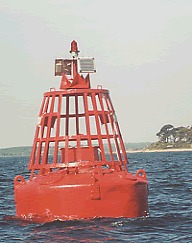
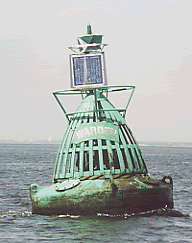
Port hand channel marker buoy. .. .. .. Starboard hand channel marker buoy.
What may be confusing about lateral or channel buoys are their designation as port and starboard. This obviously depends on the direction of travel. In the areas in which Club cruises take place the channels are buoyed for travel into Southampton.
(2) Cardinal Buoys
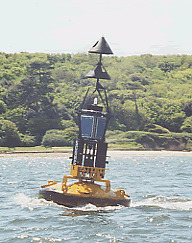
Cardinal buoys mark hazards. There are 4 types North, East, South and West. A north cardinal would be laid to the north of a hazard; you should, therefore, leave a north cardinal to your south. The N, S, E and W buoys each have different top shapes. The black and yellow bands also vary according to type.
Cardinal marks can also mark a channel edge if placed to warn, say, of a bank or shallow area. In the Solent there are few hazards marked by cardinal buoys that would concern a dinghy. The cruise master would warn of any such hazard on the course of a proposed cruise.